FAMLIES

A Framework for Advanced (Multi)Linear Infrastructure in Engineering and Science

Vertically integrated dense linear and tensor algebra software for modern scientific computing and machine learning

Scroll Down to Learn More 🡳

The Problem

For decades, the BLAS, LAPACK, and LAPACK derivatives have been part of the foundation of computational science. But their design enforces strict boundaries between layers—between single-node and multi-node computation, between matrix operations and tensor contractions, between CPU and GPU execution.

These boundaries were once a strength, but are now a liability. Memory movement is the central bottleneck of modern hardware, and one way to reduce it is to fuse operations across the stack. Existing libraries cannot do this.
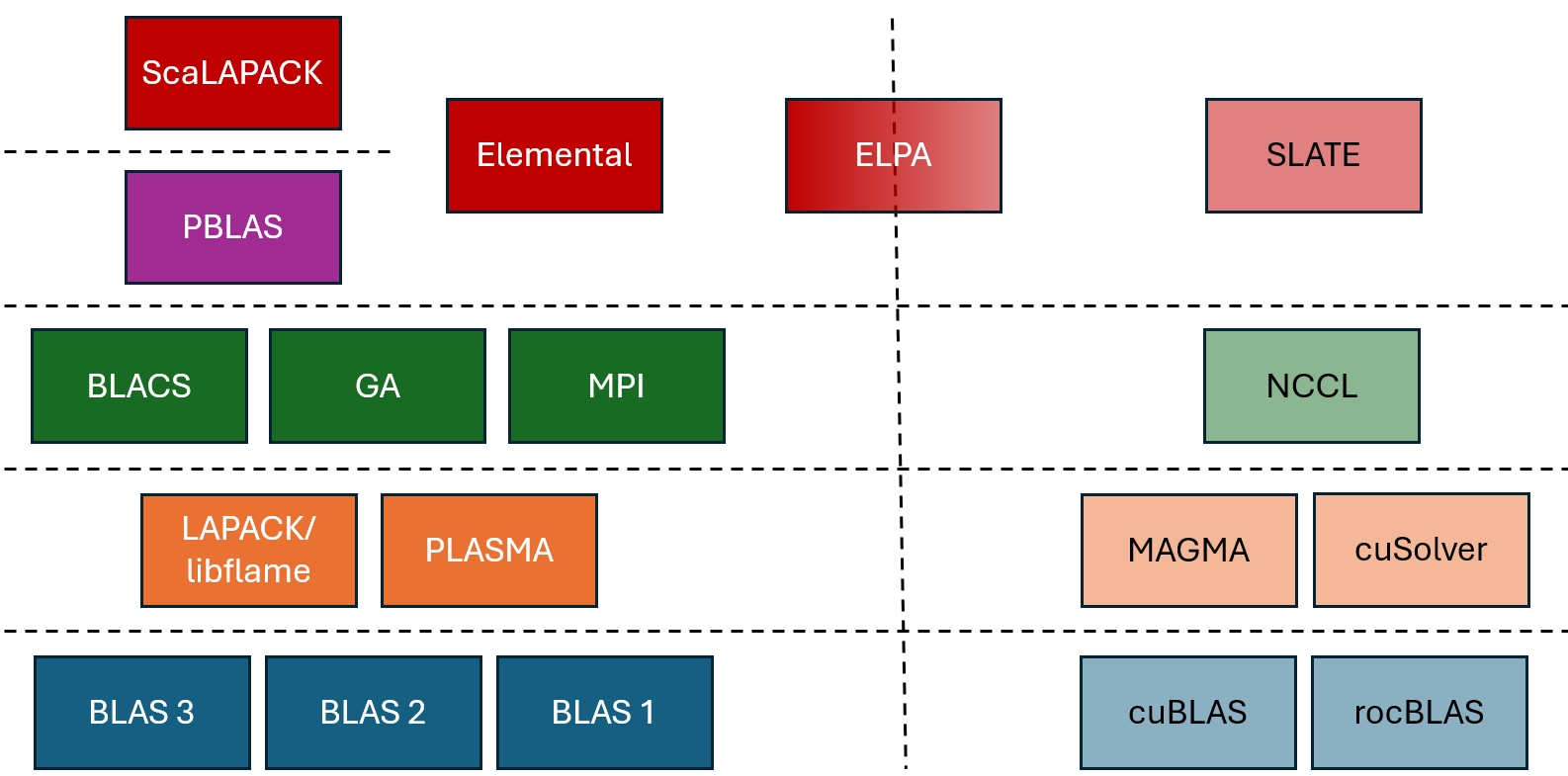
Traditional Architecture
                        Stack
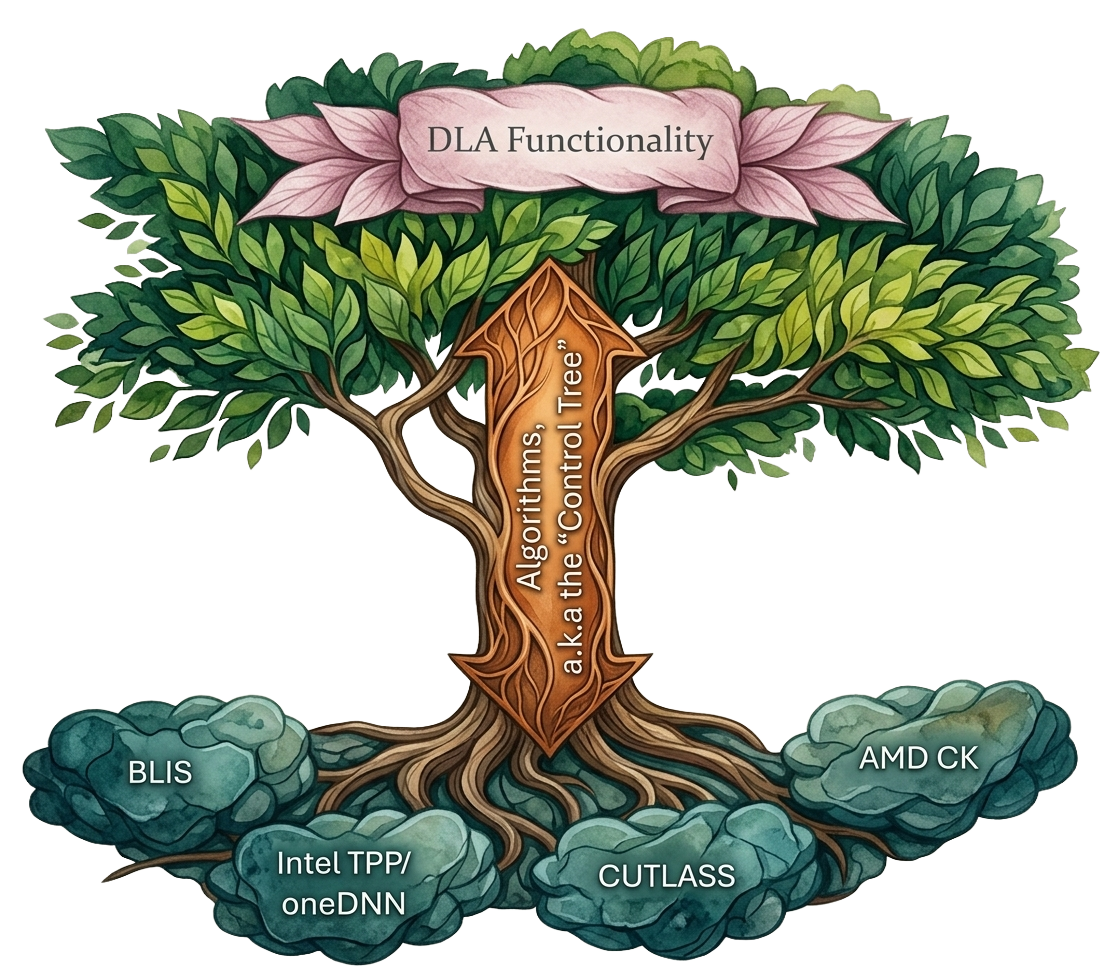
FAMLIES Control Tree

The Solution: FAMLIES

FAMLIES can. By vertically integrating layers that are today rigidly separated—from BLAS-level kernel through LAPACK-equivalent routines to distributed tensor contractions—FAMLIES aims to reduce the performance ceilings that hold back both scientific computing and modern AI workloads.

This project lays the foundation for a new framework that overcomes challenges through vertical integration, the flexible control of algorithms and communication, and a consistent programming API across levels.

Algorithm Families, Not Hard-Coded Choices

FAMLIES allows the best algorithmic variants to be selected for the problem size, target hardware, and memory hierarchy level—replacing the rigid, siloed approach of LAPACK and its descendants.

Vertical Integration Across the Full Stack

A consistent API spanning from architecture micro-kernels up through distributed computation enables cross-layer fusion and communication reduction, while increasing expressiveness and flexibility.

Unified Linear and Tensor Algebra

Dense matrix operations and tensor contractions share deep mathematical structure. FAMLIES integrates both—using building blocks from BLIS and others to power higher-order tensor operations.

Portable, Architecture-Aware Performance

Targets x86-64, ARM, IBM POWER, RISC-V, and GPU accelerators with near-optimal performance on each through architecture-specific micro-kernels.

Research Objectives

Research Objectives
Impact on Scientific Computing

Impact on Scientific Computing

FAMLIES addresses fundamental challenges in scientific computing and machine learning:

  • Reduces memory movement—the central bottleneck of modern hardware
  • Enables cross-layer fusion for communication-avoiding algorithms
  • Provides flexible algorithm selection for different hardware and problem sizes
  • Supports emerging architectures while maintaining performance
  • Creates unified abstractions across linear and tensor operations

Institutions

Multi-institutional collaboration across leading research universities

Southern Methodist
                        University Logo University of Texas at Austin Logo Carnegie Mellon University Logo

A Multi-Disciplinary Team

Multi-Disciplinary Team

Get Involved

Get Involved

Join the Conversation

Get the latest news and make your voice heard in our community

Join our Discord

FAMLIES Products

Explore the foundation libraries on GitHub

FAMLIES Repositories BLIS Repository

Meet the Team

Learn about our researchers and institutions

View Personnel